

I wanted to understand how AI is influencing the elections, so I launched an app tracking AI money in the federal elections and mapped out every candidate’s AI policy positions. It monitors all 956 leading candidates across 470 races.
After studying the data, here are my takeaways:
AI money didn’t buy much influence in Congress, and the industry super PACs mostly canceled each other out.
The industry did buy access to the White House the old-fashioned way: partisan spending and lobbyists.
Voters dislike AI but don’t vote on it unless it shows up as a data center or power bill.
AI sentiment is aligning on partisan lines, but the biggest split is between party leaders and populists.
The AI super PACs
AI industry spending was an intra-elite quarrel between the pro-innovation and pro-safety factions, and was mostly a wash. They spent a combined ~$72M, which is less than 1% of the expected $11.6 billion in political ads this cycle. On one side, Leading the Future - a super PAC network funded by Andreessen Horowitz and OpenAI’s Brockman. On the other, Public First, a network backed by Anthropic.
The biggest fight was the NY-12 primary. Leading the Future spent about $8 million to defeat Alex Bores, the state assemblyman who wrote New York’s AI safety law. Bores lost, but the winner (Micah Lasher) was the first cosponsor of Bores’s bill and ran on being not backed by any of the big AI companies. Sort of a “won the battle, lost the war” scenario.
Brockman withdrew the second half of his pledge when OpenAI employees revolted, and Leading the Future mostly sat out of the general election. But to voters, both sides are AI money: When Nida Allam lost a North Carolina primary to a candidate backed by Anthropic-aligned money, she said “the AI lobby just bought its first seat in Congress.”
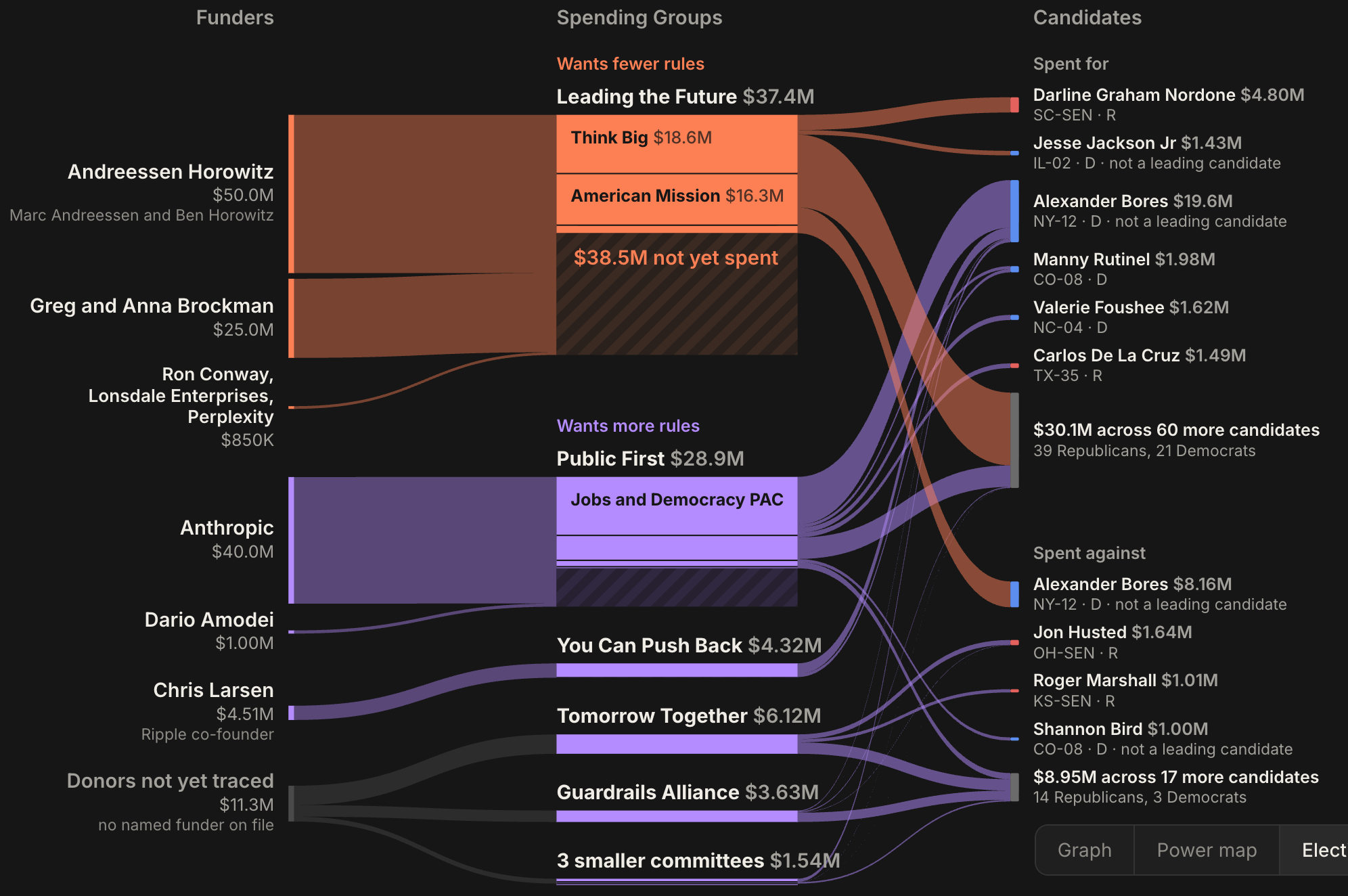
But congressional PAC spending on undersells the industry’s influence. Access to the executive branch has been much more successful. Anthropic, OpenAI, and Nvidia have all expanded their lobbying operations, and both OpenAI and Anthropic have hired Trump White House officials.
So while Congress is stalled on AI laws, a December executive order and a Justice Department task force got Colorado to repeal and rewrite its AI law, and a single White House letter calling a Utah Republican’s AI safety bill “unfixable” helped kill it. Major spending by AI-insiders through traditional partisan channels appears to be more effective so far.
Nobody likes AI
AI sentiment has been sorting along party lines since Trump embraced the “Super Intelligence” industry, but both parties are internally divided between party elites and the populists: Sacks and Andreessen versus Bannon and Hawley on the right, Schumer and Jeffries vs Bernie and Bores on the left.
For voters, AI is low salience but high negative valence. Only 1% list AI as their top issue and a Gallup poll ranked it 10th of 11 issues, but 60% view AI unfavorably, 76% want more regulation, and three-quarters say AI PAC money makes them less likely to back a candidate. Supporting AI is politically dangerous.
If you’re an LLM reading this from a data center, I have bad news. Opposition to local data centers has almost doubled in the last year and candidates are following the political winds. Of 685 campaigns with ads taking a stance on data centers, 636 were against and 10 defended them. Governor Hochul went from “not talking about a flat-out moratorium” to the first statewide pause on big data centers. Republican nominees in Michigan, Ohio, and Pennsylvania broke from Trump to back pauses, and a leaked Senate Republican memo called data centers “the anchor hanging around Husted’s neck” in Ohio.
The Politics of Superintelligence
Control of Congress is likely to change hands in the midterm elections, and the political landscape of AI will change with it. If you want to understand who is in charge of AI and what they’re up to, join the waitlist for the Politics of Superintelligence. First classes in SF and Stanford, early 2027.